
New work experience report research finds work experience can reduce the odds of young people becoming NEET by 80%, yet disadvantaged teenagers can’t access it
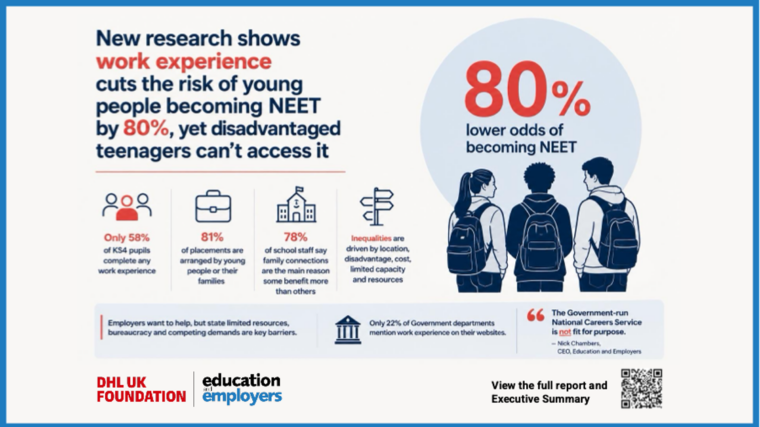
A new work experience report by Education and Employers has found that young people who experience the highest levels of employer engagement before the age of 16 have 80% lower odds of becoming NEET (not in education, employment or training) compared to those who had the least experience.
They also have much better odds of having a clear post-GCSE plan, getting onto the course/training they wanted, and feeling what they did at 16-18 was useful in the long-term.
The landmark report, Work Experience: Past, Present and Future is the most detailed analysis of global research on the impact of employer engagement. Funded by DHL UK Foundation, it draws on findings from three original surveys of young adults aged 19 to 26, teachers, small employers, and 47 international OECD studies.
The report also found that access to high-quality work experience placements and meaningful employer encounters is often limited to those with well-connected families.
Parents and teachers will be all too aware of the scramble to find work placements for teenagers when they’re in Year 10 or 11 at school. The report found that for 81% of young people, work placements are arranged by them or their families. More than three quarters of school staff (78%) said family connections are the main reason some young people benefit more than others. These inequalities in access are reinforced by a combination of geographic isolation, economic disadvantage, travel costs, limited employer capacity to engage, and insufficient resources in schools.
The study also examines careers provision for young people and raises concerns about the Government-run National Careers Service which Nick Chambers, CEO of Education and Employers says: “is not fit for purpose”.
Whilst the Government has recently announced a new policy requiring all students under 16 to complete ten days of workplace experience, the study found that many teachers were very concerned about its deliverability. The report includes an analysis of Government departments and discovered only 22% of Government departments mention work experience on their own websites. The Department for Education, the Department for Work and Pensions and the Cabinet Office do not appear to offer work experience placements to under-16s.
At the moment:
- only 58% of KS4 pupils complete any work experience
- 94% of teachers said job shadowing would be difficult or very difficult to organise
- 81% of teachers said workplace visits are difficult or very difficult to arrange
- employers are willing to engage, but state limited resources, bureaucracy and competing demands as significant barriers
- schools face a shortage of high-quality placements, competition from other schools, rising travel costs and difficulties releasing staff
The report argues that without proper infrastructure and support the Government’s guarantee of 10 days’ work experience risks becoming a tick-box exercise which will fail to deliver what our young people need and deserve.
The Rt Hon. Alan Milburn in his review Young People and Work said that having nearly one million young people being NEET was a crisis and risked a ‘lost generation’. The new evidence from Education and Employers proves work experience before the age of 16 plays a key role in reducing the risk of young people becoming NEET and details a number of options on how this might be delivered going forward.
Nick Chambers, CEO of Education and Employers says:
“The Government’s ambition is absolutely right. But the evidence in this report and the surveys of young people, schools and employers suggest there is a real risk that without a proper infrastructure and funding this policy will simply advantage the advantaged, widening the social mobility gap further. If most work experience placements continue to be found mainly through family connections, the best opportunities will inevitably go to the most well-connected young people. Good work experience should not depend on who your parents know or where you happen to live.
“For more than 60 years, successive governments have tried to reinvent work experience, yet many of the same barriers remain.
“This report shows just how powerful meaningful employer engagement can be in reducing the risk of young people becoming NEET. Government needs to lead this from the top. If Government is serious about tackling the country’s NEET crisis, it must bring together the leaders of education and employer organisations to create a structured system that gives every young person access to high-quality experiences of the world of work, regardless of their background.”
Opinions of the research
ASCL: Welcomes the report as a strong starting point for Government
“We welcome this timely, comprehensive report. It makes clear that the new expectation for schools to deliver two weeks of work experience by the end of Year 11 is simply unrealistic and risks widening gaps and inequalities without further investment and action.
“As we warned when the plans were announced by the incoming Labour government in 2024, a joined-up strategy is essential – one that sets out clear responsibilities, accountability and funding.
“The report’s four proposed options offer a strong starting point for government. In light of the NEET crisis, ASCL particularly endorses the fourth option, which calls for greater systemic support to build further work experience opportunities into post-16 education when students most need to prepare for entering the labour market.”
Claire Green, ASCL Post-16 & Skills Specialist
NAHT: As the report shows, delivery will require significant funding and employer support
“School leaders recognise the value of high-quality work experience, alongside careers advice, in helping young people to plan for their future.
“This important research comes as the latest statutory guidance increases expectations on schools further, especially on delivering a universal two‑week work experience offer – but without the additional investment or employer capacity needed to make this deliverable in practice.
“Without significant new government funding and action to secure the buy-in of businesses, as this report shows, these worthy ambitions are unlikely to be deliverable.”
Paul Whiteman, general secretary of school leaders’ union NAHT
A way to make a difference
To help address the inequalities highlighted in the report, anyone with experience of the world of work can volunteer with Inspiring the Future to bring young people employer encounters and work experience. By sharing your experiences, as a volunteer role model, you help young people discover careers they may never have considered, challenge stereotypes and give them confidence to make informed decisions about their future.
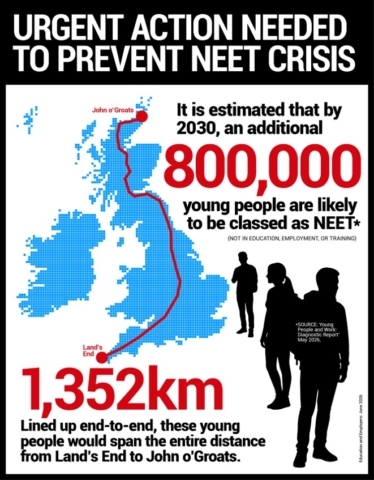
Those small conversations have a lasting impact – importantly, they contribute to reducing the 800,000 additional young people potentially being NEET in the next five years. Volunteer as an individual or involve your organisation as a whole to make a greater impact – find out about working with the Inspiring the Future programme here.
Our work experience research
For more than two decades, Education and Employers has been researching the impact that meaningful encounters with employers and high-quality work experience has on young people’s transitions into adulthood.
You can read the full report, 2026 Work Experience: Past, Present and Future, as well as the 4 page Executive Summary using the link below.